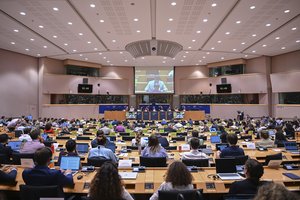
The European Parliament's lead co rapporteurs on the next multiannual financial framework (MFF) Siegfried Mureșan (EPP, RO) and Carla Tavares (S&D, PT) have firmly rejected the Irish EU Presidency's negotiating box proposal. Together with Parliament's co-rapporteurs on own resources, Danuše Nerudová (EPP, CZ) and Sandra Gómez López (S&D, ES), the Members have criticised the proposal, claiming that it was neither ambitious nor significant in comparison with the current MFF.
Irish EU Presidency's proposal
The EU Presidency presented its MFF negotiating box on 10 October 2026. The document builds on previous versions issued by the Danish Presidency on 9 December 2025, which did not contain figures, and by the Cyprus Presidency on 11 June 2026. The Irish Presidency proposes a cut to the Commission's proposal of 8 % or €141 billion. By way of comparison, this is €108.2 billion less than the Cyprus negotiating box and €316.1 billion less than Parliament's position (a difference of 16.3 %).
The cuts are spread over all headings except the common agricultural policy (CAP) and cohesion in heading 1. It does not eliminate any new own resources proposed by the Commission, but it fails to take on board any of Parliament's additional alternatives should the Commission's proposal not gain support among the Member States. Parliament considers that the revenue potential of a digital services levy aimed at major digital platforms, an online gambling and betting services levy, the extension of the carbon border adjustment mechanism and a levy based on a uniform call rate to the capital gains of crypto assets should all be explored as possible solutions.
Reduction of MFF’s real value by 10 %
The volume of the Irish negotiating box would bring the overall size of the EU long-term budget to 1.02 % of EU gross national income (GNI) without including NGEU repayments, which is below the GNI spending level of 1.14 % planned when the current MFF was negotiated. Compared with the current 2021-2027 MFF, the EU budget's real value would fall by €161 billion (-10 %) after accounting for NGEU debt repayment (€150 billion), and compensation for inflation and preserving the budget's purchasing power over the 2021-2027 period (€390 billion). This means that the EU budget would not be able to buy as many goods and services as currently and would have less capital for investment.
Parliament leaders deplore major cut
The leaders of EPP, S&D, Renew Europe and Greens/EFA groups in the European Parliament issued a common statement on the Irish proposal on 12 October 2026, criticising the proposed major cuts to the MFF, which would result in a sharp fall in the real value of the EU budget. They argue that by starting negotiations below the Commission's proposed level, the Irish Presidency would shrink the EU budget, thus undermining key European priorities and diminishing the EU's global influence. They recall that agreeing on new own resources plays a major role in financing the EU's common priorities and reducing the burden on national governments.
In its interim report on the 2028-2034 multiannual financial framework adopted on 28 April 2026, establishing its mandate for negotiations with the Council, Parliament called for a moderate increase of €175.1 billion in constant 2025 prices (approximately 10 %) compared with the Commission's July 2025 proposal. This would be allocated evenly across the three operational budget headings to support key priorities such as defence and security, competitiveness, cohesion and agriculture.
The European Commission presented its proposals for the 2028-2034 MFF on 16 July 2025. The Commission proposed a budget of almost €1.8 trillion in commitments over seven years (in constant 2025 prices), corresponding to 1.26 % of EU GNI, including 0.11 % of EU GNI for the repayment of debt created by NGEU grants.
Parliament’s consent needed for MFF
The MFF regulation requires Parliament's consent for approval, while the sectoral legislation will be agreed under the ordinary legislative procedure. Following the Irish proposal on the MFF negotiating box, the next two months will be decisive for the EU's budgetary authority to deliver an agreement on the long-term budget. This need was stressed in a meeting of Parliament's Conference of Presidents on 30 September 2026, which underlined the importance of reaching agreement by the end of the year for a sufficiently funded MFF that meets citizens' expectations. The Conference of Presidents' decision of 12 March 2026 calls for the adoption of all MFF related reports in committee in time for consideration in plenary by the November II part session.
At its meeting on 15 and 16 October 2026, the European Council discussed the key elements of a balanced compromise on the next MFF and invited its President to take the negotiations forward with a view to a timely agreement. An agreement before the end of 2026 would allow the legislative acts to be adopted in 2027, so that EU funding reaches beneficiaries without interruption from January 2028. The European Council’s Leaders’ Agenda 2026 foresees a special European Council on 26-27 November 2026, expected to focus on the MFF. The next regular European Council meeting is scheduled for 17-18 December 2026, where the MFF is expected to feature again.
More info
For a general overview of the EU’s long-term budget, visit: